Recursive is a frontier AI research company building systems that improve themselves. Its goal is to make open-ended recursive self-improvement a practical engineering discipline: AI that generates its own curriculum of challenges, solves them, learns from failure, and critically, improves the very machinery that produces the next generation of improvement. Rather than building another application layer on top of existing models, Recursive is pursuing a deeper question: how do we build AI systems that continuously generate new problems, compound capability over time, and become active participants in their own development?
At Soma Labs, we invest in frontier AI companies before consensus has formed, which is when the defining signal is not revenue, distribution, or even product-market fit, but the quality of the technical insight and the caliber of the researchers and engineers pursuing it. Recursive is exactly the kind of company we built Soma Labs to back.
1. WHAT WE OBSERVE ABOUT THE SCALING ERA
The last five years of AI were defined by a simple recipe: scale external inputs. More compute, more data, more parameters produced predictable gains, and that recipe built the frontier we have today. But our research across frontier labs, neolabs, and the compute stack concludes that the age of pure input scaling is ending. Inference costs make ever-larger transformers unaffordable to serve at scale, and there is a ceiling on globally available compute for pre-training and post-training. The "is scaling dead?" debate has dissolved into an efficiency race, and the field is being forced toward new mechanisms of progress.
In the near term, we observe the field responding with algorithms and harnesses: methods that squeeze more efficiency and performance out of existing models across pre-training, post-training, and inference. These matter, but they share a structural limitation where they improve the model from the outside, against fixed objectives. A system given a task, a reward function, or a benchmark optimizes toward it; once the task is solved, learning saturates. In our research on continual learning, we have mapped the camps chasing post-deployment improvement — memory and context, reinforcement learning and post-training, and approaches that make improvement a property of the system itself. Our conclusion is consistent: the first two hit ceilings, and only the third makes gains durable and compounding.
At the same time, a threshold has been crossed. Frontier models are no longer only passive assistants; they increasingly operate as autonomous engineers. They can read codebases, identify bugs, write patches, run tests, interpret feedback, and iterate toward solutions. For the first time, the agent inside an improvement loop is capable enough to be trusted with the loop itself.
Put together, these observations define how we believe the next phase of AI will be enabled: not by adding more external inputs, but by systems that improve the process of improvement. The organizing principle is open-endedness. Open-ended systems generate the next puzzles worth solving. They search for novelty, learnability, failure modes, and capability gaps, and create their own curriculum, so that self-generated challenges become stepping stones toward broader intelligence. Biological evolution remains the clearest existence proof: it never optimized toward a fixed endpoint, yet continuously generated new organisms, niches, and capabilities through a vast open-ended search. The question for AI is whether we can engineer analogous computational systems.
2. RECURSIVE'S ANSWER: OUR INVESTMENT THESIS
Recursive is one of the few companies explicitly building toward this paradigm, and it answers each of our observations directly. Our conviction rests on three points.
First, a fundamental research discontinuity: recursive self-improvement as a new scaling law.
Traditional scaling laws improve models by increasing external inputs. Recursive changes the object of optimization: instead of only improving the model, the system improves the machinery that improves the model. A stronger system becomes better at generating useful tasks, identifying its own weaknesses, and modifying code, data pipelines, evaluation harnesses, and architectures. Each generation improves not only performance, but the rate at which future performance sees the possibility of superlinear, compounding progress precisely where input scaling saturates. Early research signals, including Darwin Gödel Machine, Promptbreeder, AI Scientist, and POET, support the plausibility of this direction. It remains one of the hardest technical problems in AI, but that is exactly why it matters. If solved, it becomes a foundational platform shift.
Second, deep founder–problem fit.
We do not invest in frontier research themes abstractly; we invest when the right technical direction meets an exceptional team with unfair insight into the problem. The people building Recursive are not tourists in this domain. They are among the researchers who have created the underlying fields in open-endedness, AI-generating algorithms, self-play, and self-referential improvement, that make this company possible.
Third, an economically meaningful commercial wedge.
Recursive's first target domains in software engineering, AI/ML engineering, data science, and scientific research, are high-value digital labor markets with objective feedback loops. These are exactly the domains where autonomous systems can demonstrate measurable performance, iterate quickly, and create large economic value. If Recursive succeeds in technical domains, it can expand horizontally across the broader universe of digital work.
3. WHY WE BELIEVE THIS TEAM CAN EXECUTE
Recursive's founding team is one of the strongest we have seen in frontier AI, bringing together researchers and operators from DeepMind, OpenAI, Meta AI, Google Brain, Salesforce AI Research, Uber AI Labs, You.com, and Cresta. More importantly, their expertise maps directly onto the core requirements for building recursively self-improving systems: open-endedness research, reinforcement learning, foundation model architecture, autonomous code agents, benchmarking, infrastructure, productization, and commercialization. The founding team covers precisely these domains.
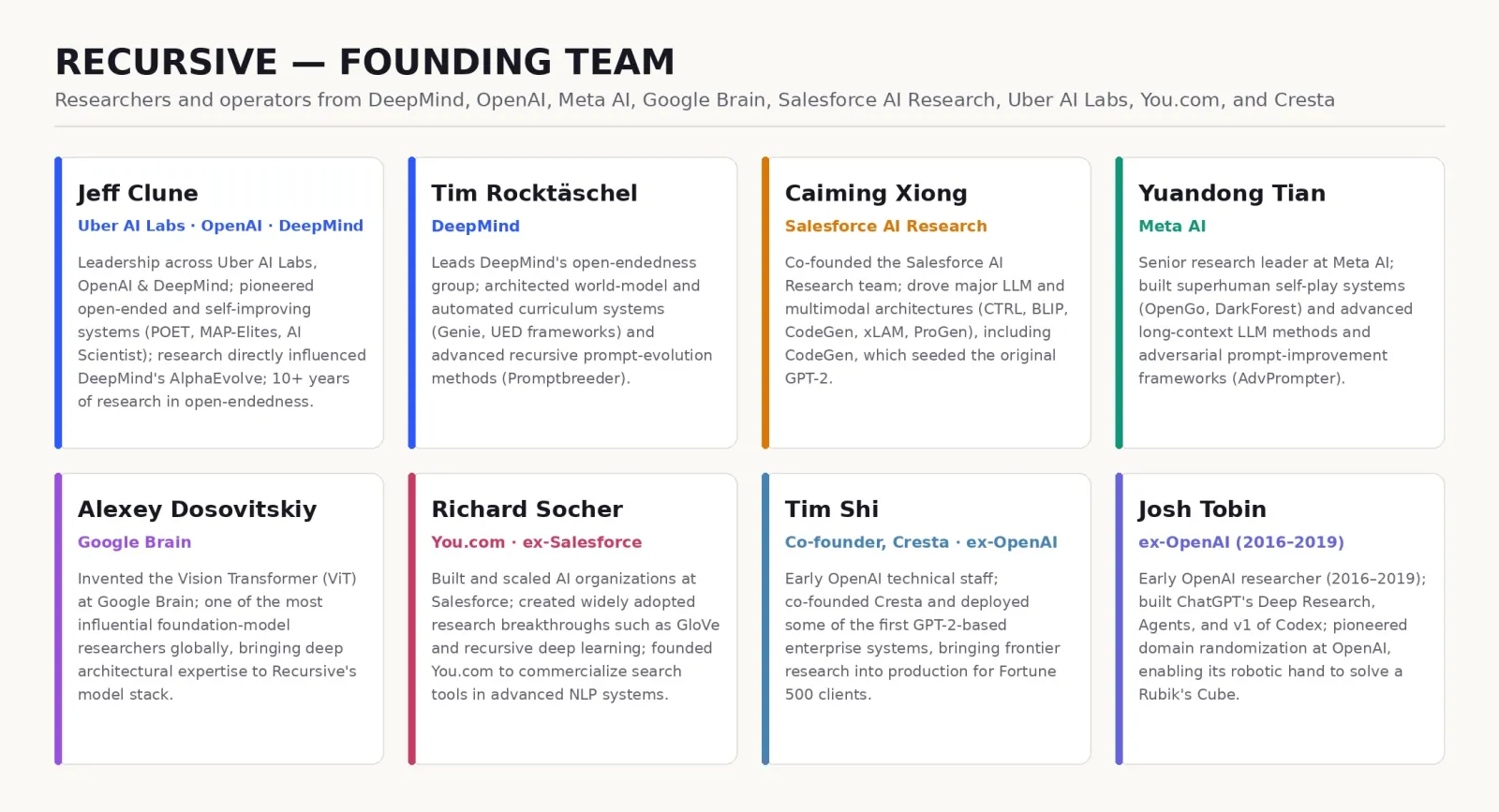
Recursive Founding Team — Researchers and operators from DeepMind, OpenAI, Meta AI, Google Brain, Salesforce AI Research, Uber AI Labs, You.com, and Cresta
This is not simply a famous-name team. It is a technically coherent one and that is what gives us conviction that the vision can be executed, not just articulated.
4. WHY WE BACK THEM: THE RESEARCH STANDPOINT
Soma Labs was created to back the best researchers and engineers at the moment when frontier science becomes company creation. We believe the most important AI companies of the next decade will not look like ordinary SaaS startups. They will often begin as research organizations, whose earliest assets are technical talent, research velocity, and proprietary systems insight. Their initial product may not be obvious. Their market may look too early. Their ambition may sound unreasonable. That is usually where the best opportunities begin.
Recursive sits at the center of our Frontier AI pillar: the models and architectures expanding what machines can reason, create, and do. The market has already rewarded foundation model labs, coding agents, enterprise copilots, and infrastructure companies. But we believe the next frontier will be defined by systems that do more than respond, generate, or execute. The next frontier is AI that can be discovered, and Recursive has assembled one of the few teams with technical depth, research taste, and execution credibility to pursue that path directly.
At Soma Labs, we want to be the first institutional partner for companies like this — before the market fully understands them, before the category is obvious, and before the opportunity becomes consensus.
Recursive is not just building a better AI product. It is building toward a new mechanism for intelligence itself. That is why we invested.